
Manifestos and texts
The Chymical Wedding of Christian Rosenkreuz
Seven days, an invitation to a king's wedding, guests weighed on a scale, sovereigns beheaded and brought back to life in a tower: the most enigmatic alchemical romance of the seventeenth century.
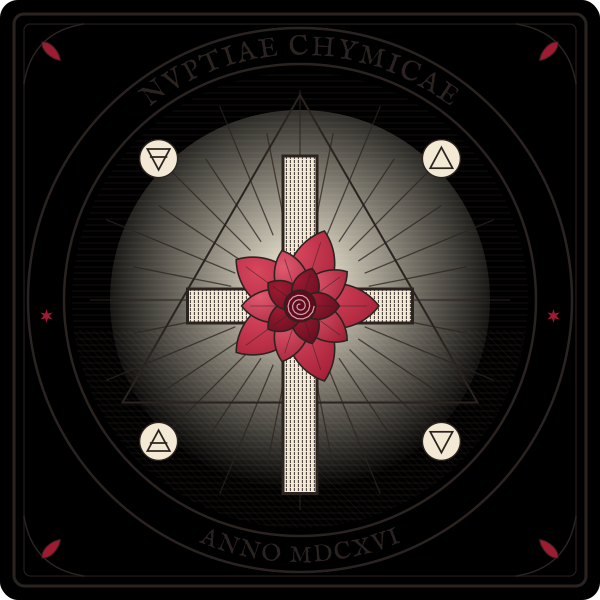
On Easter Eve in the year 1459, while praying in his room, the old Christian Rosenkreuz is shaken by a violent wind. A female figure dressed in blue appears to him, her wings covered with eyes, and hands him a sealed letter: it is an invitation to a king's wedding. So begins the third and strangest of the Rosicrucian texts, published in Strasbourg in 1616: the Chymical Wedding.
An invitation with a sign
On the letter is drawn a symbol that the educated reader of the time could recognise: the Hieroglyphic Monad of the Englishman John Dee, a sign that combined the symbols of the planets and the elements in a single figure. The invitation warns that only those who have prepared themselves carefully may attend without harm. Rosenkreuz dresses in white, with a red band crossed over his shoulders and four red roses in his hat. He sets out.
The scale
After a journey full of trials — three different roads, guarded gates, a lion, tests of humility — he reaches the castle, where he finds a crowd of presumptuous guests: false sages, charlatan alchemists, vain noblemen. On the third day they are all weighed on a golden scale, with weights representing the virtues. Many prove too light and are driven out in shame or punished. Rosenkreuz, who had considered himself unworthy, passes the test.
Death and resurrection of the sovereigns
On the fourth day he watches a theatrical performance and then a terrible scene: three royal couples are beheaded by a man dressed in black, who is then killed in turn. Their bodies are carried by sea to a tower. There, over the following days, the chosen guests carry out a series of alchemical operations: distillations, meltings, the birth of a bird that is fed on blood and then beheaded, the creation of two small human figures into which life is breathed. In the end a king and a queen return to life, younger and more splendid than before.
It is a transparent allegory of the alchemical great work, in which matter must die and putrefy in order to be reborn purified. But it is also the story of an inner transformation, a spiritual rebirth.
One page too many
On the seventh day Rosenkreuz is made a knight of the Golden Stone. But there is a shadow: on the fifth day, out of curiosity, he had spied into a secret room and seen Venus sleeping naked on a bed. For this indiscretion he will have to stay as guardian at the castle gate. The romance breaks off abruptly, with a note saying that two leaves are missing: the reader is left hanging, as before an unfinished initiation.
The author and the interpretations
Johann Valentin Andreae, in his autobiography, admitted that he had written the Chymical Wedding as a young man, around 1605, and called it a ludibrium, a literary jest full of monsters. Yet the text is too carefully built, too rich in symbols, to be merely a game. Scholars recognise in it elements of Lutheran theology, Paracelsian alchemy and the theatrical culture of the time.
In the twentieth century the romance fascinated very different readers: the psychologist Carl Gustav Jung, who saw in it a record of the process of individuation, and Rudolf Steiner, who devoted a spiritual commentary to it. To this day the Chymical Wedding remains one of the most evocative gateways into Hermetic thought: an adventure story in which every detail seems to hide another meaning.
Watch the video
Sources and further reading
- Chymische Hochzeit Christiani Rosencreutz anno 1459 (Strasbourg, 1616)
- J. V. Andreae, Vita ab ipso conscripta
- R. Steiner, The Chymical Wedding of Christian Rosenkreutz (1917-1918)
- R. Edighoffer, Rose-Croix et société idéale selon Johann Valentin Andreae (1982)
Read next
The Rosicrucian Manifestos
Between 1614 and 1616 three anonymous booklets announce to Europe the existence of a secret brotherhood of sages. Nobody knows where it is, everybody looks for it: so the Rosicrucian myth is born.
Christian Rosenkreuz, the legendary founder
Born in 1378, raised in a monastery, taught by the sages of the East, buried in a seven-sided vault found 120 years later: the life of the founder of the Rosicrucians according to the manifestos.
Johann Valentin Andreae, the theologian behind the Rosicrucians
Grandson of a Lutheran reformer, traveller, utopian, admirer of Campanella: the man who wrote the Chymical Wedding and then called the whole Rosicrucian affair “a game”.
