Rosicrucians · Initiatory societies
Rose + Cross
Three anonymous booklets printed between 1614 and 1616 announce an invisible brotherhood of sages. Nobody finds it, everybody looks for it: this is where the history of modern initiatory societies begins.
In 1614 a booklet printed in Kassel announced to Europe the existence of a secret brotherhood: learned men who for two centuries had kept a wisdom capable of reforming religion, medicine and the knowledge of nature, and who now invited the best minds to join them. They were called the brothers of the Rose Cross. Nobody ever managed to find them. And yet from that moment the idea of a hidden, benevolent initiatory society has never stopped fascinating the West.
This site tells that story. We begin with the three manifestos — the Fama, the Confessio, the Chymical Wedding — and with their legendary founder, Christian Rosenkreuz. We meet the theologian who probably conceived them, Johann Valentin Andreae, and the two great defenders of the Fraternity, Michael Maier and Robert Fludd, with their books of engravings. We then follow the societies that claimed that heritage: French Martinism, the London Golden Dawn, and two Italian figures, Cagliostro from Palermo and Giuliano Kremmerz from Naples.
Each entry carefully separates documented history from legend and cites its sources. Each one comes with an original emblem inspired by the alchemical engravings of the seventeenth century.
Latest entries
All entries (20)
The Alchemical Door of Rome
The last door of a vanished villa on the Esquiline, covered with planetary symbols and Latin mottoes: the Marquis Palombara, Queen Christina and the legend of the pilgrim who made gold.
V.I.T.R.I.O.L., the hidden stone
Seven Latin words hidden in the name of a chemical substance: "visit the interior of the earth, by rectifying you will find the hidden stone". From alchemy to the Masonic chamber of reflection.
The degree of Knight Rose-Croix
In the Ancient and Accepted Scottish Rite the eighteenth degree bears the name of the Rose+Cross: the lost word recovered, the pelican, the cross and the rose, faith, hope and charity.
The Rosicrucians of the twentieth century
Max Heindel's Rosicrucian Fellowship, Harvey Spencer Lewis's AMORC, the Lectorium Rosicrucianum: how the name of the Rose+Cross became that of spiritual movements spread across the world.
The Societas Rosicruciana in Anglia
A society of scholarly Freemasons founded in London in the mid-nineteenth century, with nine grades and a Supreme Magus: the cradle from which the founders of the Golden Dawn emerged.
The Golden Rosicrucians of the eighteenth century
A secret German order of Christian alchemists, nine grades that would pass to the Golden Dawn and two ministers of the King of Prussia: the Rose+Cross in the Age of Enlightenment.
The Invisible College
A castle with wings and wheels, posters on the walls of Paris, Descartes under suspicion, Boyle and the birth of the Royal Society: how the Fraternity no one could find became an idea.
Heinrich Khunrath and the Amphitheatre of Wisdom
A Paracelsian physician from Leipzig joined prayer, Christian Kabbalah and alchemy in a book of circular plates: the laboratory beside the oratory, the most famous image of Hermetic knowledge.
John Dee and the Hieroglyphic Monad
Mathematician to Elizabeth I, book collector, interpreter of angels: his monad sign reappears in the Chymical Wedding, and for Frances Yates the Rosicrucians were born in his wake.
Paracelsus, the physician who burned Avicenna
Wandering physician, alchemist, reformer of medicine and father of the elemental spirits: Paracelsus died in 1541, but the Rosicrucian manifestos treat him as a forerunner.
The symbol of the Rose+Cross
A rose blooming at the centre of a cross: where the Rosicrucian symbol comes from, what it means and how the orders transformed it from the seventeenth century to today.
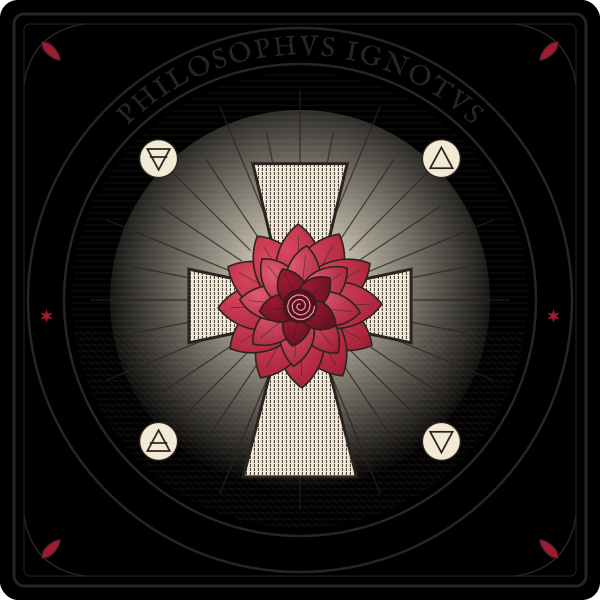
Martinism
A mysterious theurgist, Martinez de Pasqually; his secretary Louis-Claude de Saint-Martin, the “Unknown Philosopher”; and the order founded by Papus: the way of the heart of French Christian esotericism.
Videos from the YouTube channel
All videos (85)Videos by Studio Esoterico Cornelio on the themes of this website. They are in Italian: watch them here or on YouTube, and subscribe to see the next ones.
Subscribe to the channel YouTube channel · Studio Esoterico Cornelio
Explore by theme

Studio Esoterico Cornelio®
This website is an editorial project of Studio Esoterico Cornelio®: the history, symbols and traditions of esotericism, told with care.