
Orders and societies
The Hermetic Order of the Golden Dawn
London, 1888: three Freemasons found the Golden Dawn, the school of ceremonial magic that trained Yeats, Waite and Crowley, built its grades on the Tree of Life and shaped the whole of twentieth-century occultism.
On 1 March 1888 the Isis-Urania temple of a new initiatory society was inaugurated in London: the Hermetic Order of the Golden Dawn. Within a few years it became the laboratory of modern ceremonial magic, frequented by poets, actors, doctors and artists, and its system of rites and symbols would influence almost all twentieth-century occultism.
The founders and the cipher manuscript
The founders were three British Freemasons, also members of the Societas Rosicruciana in Anglia: the coroner William Wynn Westcott, the eccentric scholar Samuel Liddell MacGregor Mathers and the physician William Robert Woodman. At the basis of the order lay a peculiar document, the so-called Cipher Manuscript: a few dozen leaves written in a simple code describing the outline of a series of rituals. Westcott claimed to have received, together with the manuscript, the address of a German adept, Anna Sprengel, who authorised the foundation. Historians consider it very likely that she never existed.
The Tree of Life
The Golden Dawn organised initiation in grades corresponding to the spheres of the Kabbalistic Tree of Life, from Neophyte up to the grades of Adept. Its teaching was a synthetic system combining Kabbalah, astrology, alchemy, geomancy, tarot, Egyptian symbolism and the Enochian magic of the Elizabethan John Dee. Students learned the correspondences between planets, Hebrew letters, colours and trumps, and were taught to make talismans, to perform purification rituals and to practise visualisation.
The Red Rose and the Golden Cross
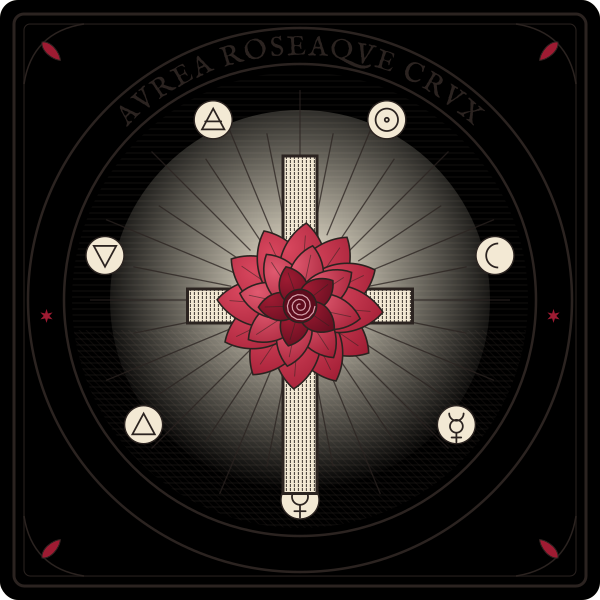
In 1892 Mathers created an Inner Order, reserved for the most advanced members, with an eloquent Latin name: Rosae Rubeae et Aureae Crucis, of the Red Rose and the Golden Cross. At its centre stood the vault of Christian Rosenkreuz, rebuilt as a seven-sided ritual space on the model of the tomb described in the Fama Fraternitatis. The Golden Dawn thus presented itself as the direct heir of the Rosicrucian tradition.
Poets and magicians
Its members included the Irish poet William Butler Yeats, a future Nobel laureate, who joined in 1890; the actress Florence Farr; the painter Moina Mathers, the founder's wife and sister of the philosopher Henri Bergson; the writer Arthur Machen; the scholar Arthur Edward Waite. It was Waite who conceived the famous tarot deck drawn by Pamela Colman Smith, also a member of the order, published in 1909. In 1898 an ambitious young man joined the order: Aleister Crowley.
The Battle of Blythe Road
The order soon split. Mathers, who had moved to Paris, ruled in an increasingly authoritarian way; in 1900 the London members rebelled. Crowley, siding with Mathers, tried to occupy the premises of the Inner Order in London, in Blythe Road: the episode, with threats and police involvement, has gone down in history as the “Battle of Blythe Road”. Several successor orders emerged from the crisis, including the Stella Matutina and the Alpha et Omega.
An open legacy
In the 1930s Israel Regardie, Crowley's former secretary and a former member of the Stella Matutina, published the order's rituals and teachings, making them available to all. Since then the Golden Dawn system has been studied, adapted and practised by countless groups all over the world. Few secret societies have had so great an influence — or one so little secret.
Watch the video
Sources and further reading
- I. Regardie, The Golden Dawn (1937-1940)
- E. Howe, The Magicians of the Golden Dawn (1972)
- R. A. Gilbert, The Golden Dawn Companion (1986)
- W. B. Yeats, Autobiographies
Read next
Martinism
A mysterious theurgist, Martinez de Pasqually; his secretary Louis-Claude de Saint-Martin, the “Unknown Philosopher”; and the order founded by Papus: the way of the heart of French Christian esotericism.
The Invisible College
A castle with wings and wheels, posters on the walls of Paris, Descartes under suspicion, Boyle and the birth of the Royal Society: how the Fraternity no one could find became an idea.
The Golden Rosicrucians of the eighteenth century
A secret German order of Christian alchemists, nine grades that would pass to the Golden Dawn and two ministers of the King of Prussia: the Rose+Cross in the Age of Enlightenment.
