
People
Michael Maier and Robert Fludd, defenders of the Fraternity
An alchemist physician at the court of Rudolf II and a London physician with a passion for the cosmos: the two great defenders of the Rosicrucians and their illustrated books, masterpieces of seventeenth-century engraving.
When the Rosicrucian manifestos shook Europe, most of the replies came from minor authors: the curious, the enthusiastic, the polemical. Two voices, however, stood out for their learning and prestige: those of the German Michael Maier and the Englishman Robert Fludd. Both physicians, both alchemists, both authors of extraordinarily illustrated books.
Maier, the emperor's physician
Michael Maier, born in 1568 in Holstein, studied medicine and became personal physician to Emperor Rudolf II in Prague, the European court most open to the arts and the occult sciences. After the emperor's death he lived in England and then at various German courts, devoting himself to writing. In 1617 and 1618 he published works in defence of the Fraternity: Silence after the Clamours and the Themis aurea, in which he explained that the Rosicrucians, if they existed, had every reason to stay hidden, and set out their rules. He never declared himself a member.
Atalanta fugiens
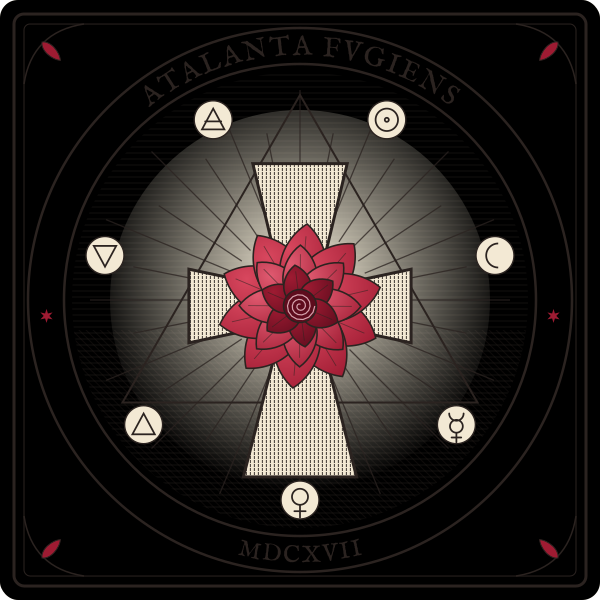
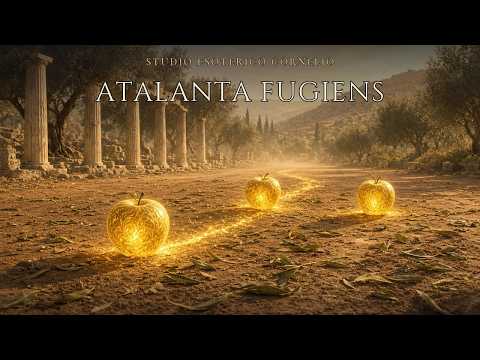
His masterpiece is the Atalanta fugiens, published at Oppenheim in 1617 by the publisher Johann Theodor de Bry. It is one of the most original books ever printed: fifty alchemical emblems engraved on copper, attributed to the workshop of Matthäus Merian, each accompanied by a motto, a Latin verse epigram, a prose commentary and a musical fugue for three voices. A book to be looked at, read and sung at the same time: almost a multimedia work before its time.
The title comes from the myth of Atalanta, the swift huntress whom Hippomenes managed to beat in a race by dropping three golden apples. In Maier's reading, Atalanta flees like volatile mercury, and the golden apples are the means by which the alchemist holds it back and fixes it.
Fludd, the physician of the cosmos
Robert Fludd was born in Kent in 1574, studied at Oxford and travelled widely on the Continent, including Italy. Back in London he became an established physician and a fellow of the College of Physicians. In 1616 he published a short Apology for the Fraternity of the Rose Cross, followed by a longer treatise. He too defended the ideas of the manifestos without claiming to belong to the order.
His major work, the History of Both Worlds, published at Oppenheim between 1617 and 1621, again by de Bry, sets out to describe the macrocosm, the universe, and the microcosm, the human being, as mirrors of each other. Its plates have become icons: the great monochord, in which the hand of God tunes the spheres of the universe like the strings of an instrument; man inscribed within the heavenly circles; the creation of the world from darkness to light.
The controversies
Fludd was attacked by some of the sharpest minds of his time. Kepler challenged his vision of the harmony of the world as too symbolic and not mathematical enough; the Minim friar Marin Mersenne and the philosopher Pierre Gassendi accused him of confusing science and magic. Fludd replied to them all with vigour. Those controversies mark a crucial moment: the parting of ways between the new experimental science and the Hermetic tradition, which until then had walked together.
Two bridges to the future
Maier died in 1622, Fludd in 1637. Thanks to them Rosicrucianism ceased to be merely a literary riddle and became a current of thought: spiritual alchemy, medicine, cosmic harmony, symbol. Their engravings, reproduced countless times, gave a face to the Western esoteric imagination, and some still appear today in books, on covers and in works of art.
Watch the video
Sources and further reading
- M. Maier, Atalanta fugiens (Oppenheim, 1617)
- M. Maier, Silentium post clamores (1617)
- M. Maier, Themis aurea (1618)
- R. Fludd, Apologia compendiaria Fraternitatem de Rosea Cruce (1616)
- R. Fludd, Utriusque cosmi historia (1617-1621)
- J. Godwin, Robert Fludd (1979)
Read next
Johann Valentin Andreae, the theologian behind the Rosicrucians
Grandson of a Lutheran reformer, traveller, utopian, admirer of Campanella: the man who wrote the Chymical Wedding and then called the whole Rosicrucian affair “a game”.
Cagliostro, the magician from Palermo
Born Giuseppe Balsamo in the Albergheria quarter, he became Count Cagliostro: healer, founder of an Egyptian Freemasonry, protagonist of the necklace scandal, who died a prisoner at San Leo.
Giuliano Kremmerz and the Brotherhood of Myriam
A nineteenth-century Neapolitan, a magazine called “Il Mondo Secreto” and a brotherhood devoted to healing: the key figure of modern Italian Hermeticism.
