
Symbols
The Alchemical Door of Rome
The last door of a vanished villa on the Esquiline, covered with planetary symbols and Latin mottoes: the Marquis Palombara, Queen Christina and the legend of the pilgrim who made gold.
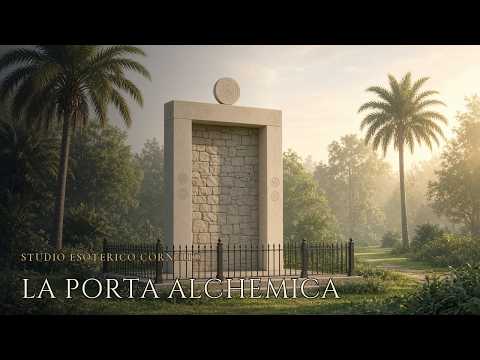
In the gardens of Piazza Vittorio Emanuele II, in Rome, behind a railing, there is a walled-up door that leads nowhere. Symbols of planets and metals and enigmatic Latin sentences are carved on its jambs and lintel; above it, a disc with a six-pointed star. It is the Magic Door or Alchemical Door, the only remnant of the villa that the Marquis Massimiliano Savelli Palombara had built on the Esquiline in the seventeenth century.
The alchemist marquis
Massimiliano Palombara lived from 1614 to 1680. He frequented the Roman circle of Queen Christina of Sweden, who after her abdication and conversion to Catholicism had settled in Rome and set up an alchemical laboratory there. In 1656 Palombara wrote a short poem, La Bugia, in which he explicitly invokes the brothers of the Rose+Cross. The historian Mino Gabriele, who published it, has called him an alchemist and a Rosicrucian.
The inscriptions
On the door the planetary symbols go together with the metals and with Latin mottoes describing alchemical operations: the dissolution, coagulation, death and rebirth of matter. On the threshold is a palindromic sentence, Si sedes non is: read from the left it means "if you sit you do not go", read backwards "if you do not sit you go". The upper disc holds the six-pointed star, a symbol of the union of opposites, and inscriptions on the Trinity and on the centre hidden in the triangle.
The legend of the pilgrim
According to a story told at the beginning of the nineteenth century, a mysterious pilgrim was given hospitality in the villa to look for a herb able to produce gold. The next morning he had vanished, leaving flakes of gold in the crucible and a sheet full of symbols that the marquis could not decipher and had carved on the doors of the villa, hoping someone might one day read them. Some have identified the pilgrim with Giuseppe Francesco Borri, a Milanese alchemist tried by the Inquisition; but this is legend, not documented fact.
From villa to garden
The villa was demolished in the nineteenth century, during the building of the new Esquiline quarter after Rome became the capital. The door was saved and reset in the garden of the square, flanked by two statues of the Egyptian god Bes from other excavations, which have nothing to do with alchemy but add to its fascination.
A page of stone
Today the Alchemical Door is one of the most visited places of esoteric Rome. Reading it means reading a small seventeenth-century alchemical treatise written in marble, born in the same climate that produced the Chymical Wedding and the motto V.I.T.R.I.O.L., in the shadow of the symbol of the Rose+Cross.
Watch the video
Sources and further reading
- M. Gabriele, Il giardino di Hermes. Massimiliano Palombara alchimista e rosacroce nella Roma del Seicento (1986)
- M. Palombara, La Bugia (1656)
- F. Cancellieri, notes on the Villa Palombara (early 19th c.)
- Comune di Roma, Sovrintendenza capitolina, entry on the Porta Magica
Read next
The symbol of the Rose+Cross
A rose blooming at the centre of a cross: where the Rosicrucian symbol comes from, what it means and how the orders transformed it from the seventeenth century to today.
V.I.T.R.I.O.L., the hidden stone
Seven Latin words hidden in the name of a chemical substance: "visit the interior of the earth, by rectifying you will find the hidden stone". From alchemy to the Masonic chamber of reflection.
The Rosicrucian Manifestos
Between 1614 and 1616 three anonymous booklets announce to Europe the existence of a secret brotherhood of sages. Nobody knows where it is, everybody looks for it: so the Rosicrucian myth is born.
