Symbols
The symbol of the Rose+Cross
A rose blooming at the centre of a cross: where the Rosicrucian symbol comes from, what it means and how the orders transformed it from the seventeenth century to today.
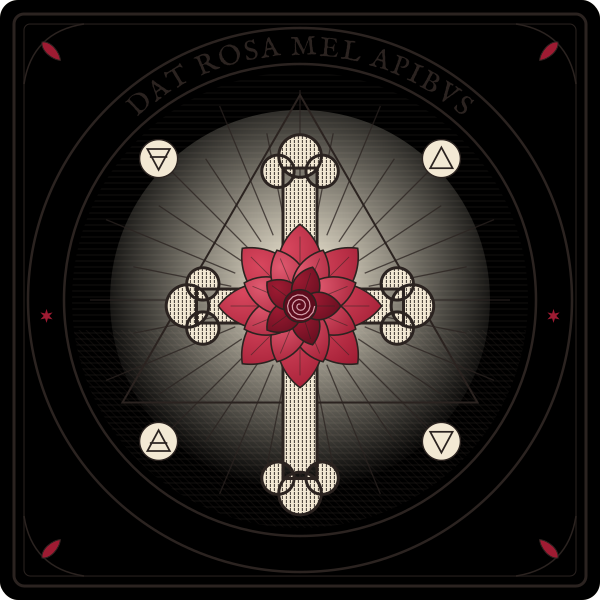
The best-known symbol of the Rosicrucian tradition is also one of the simplest: a rose at the centre of a cross. Two very ancient signs, each charged with meaning, joined in an image that from the seventeenth century onward became the emblem of a whole spiritual current.
The rose
In European culture the rose is the flower above all others: beauty, love, youth, but also pain, because of its thorns. In Christian tradition it is the symbol of Mary, the “mystical rose” of the litanies, and of the blood of the martyrs. At the end of the Paradiso Dante imagines the blessed arranged like the petals of a “white rose” opening around the light of God. The rose is also the flower of secrecy: the Latin expression sub rosa, “under the rose”, indicated what was to remain confidential.
The cross
The cross is the Christian sign above all others, the wood of sacrifice and redemption. But it is also a universal symbol, older than Christianity: the meeting of the vertical and horizontal lines, of heaven and earth, the four cardinal points, the four elements. In Hermetic language it often represents the world of matter.
The union of the two signs
Put together, the rose and the cross tell of a transformation: spirit flowering in matter, the soul opening through trial, life born from sacrifice. In the seventeenth-century manifestos the symbol remains discreet, almost implicit in the name; it would be later commentators and orders that developed it.
Possible origins
Two precedents are often cited. The first is Martin Luther's seal, which the reformer described in a letter of 1530: a black cross in a red heart, set at the centre of a white rose, on a sky-blue field, within a golden ring. The second is the coat of arms of Johann Valentin Andreae's family, with a Saint Andrew's cross and four roses. The Lutheran circle in Tübingen that produced the manifestos knew both well.
Dat rosa mel apibus
In 1629 the title page of the Summum bonum, a work published under a pseudonym and attributed to Robert Fludd, showed an image destined to become famous: a seven-petalled rose on a cross, surrounded by bees, with the motto Dat rosa mel apibus, “the rose gives honey to the bees”. The bees are souls in search of spiritual nourishment; the rose blooming on the cross is the source from which they draw it.
The rose crosses of the orders
Each later Rosicrucian society developed the symbol in its own way. The Golden Dawn created a complex emblem, the Rose Cross lamen, in which the rose has twenty-two petals, as many as the letters of the Hebrew alphabet, arranged in three tiers, while the cross bears the symbols of the elements and planets. The Rosicrucian order founded in New York in 1915, known by the acronym AMORC, adopted a golden cross with a single red rose at its centre; other groups a cross surrounded by seven roses. In Freemasonry there is a degree called Prince Rose+Croix, one of the high degrees of the Scottish Rite.
A living symbol
The strength of the rose on the cross lies in its ability to say different things without contradicting itself: pain and beauty, secrecy and revelation, earth and heaven. That is why, four centuries after the manifestos, it still speaks to those who look at it.
Watch the video
Sources and further reading
- Martin Luther, letter to Lazarus Spengler (1530)
- Fama Fraternitatis (1614)
- R. Fludd (attrib.), Summum bonum (1629)
- Dante, Paradiso XXX-XXXI
- I. Regardie, The Golden Dawn
- J. Godwin, The Golden Thread (2007)
Read next
V.I.T.R.I.O.L., the hidden stone
Seven Latin words hidden in the name of a chemical substance: "visit the interior of the earth, by rectifying you will find the hidden stone". From alchemy to the Masonic chamber of reflection.
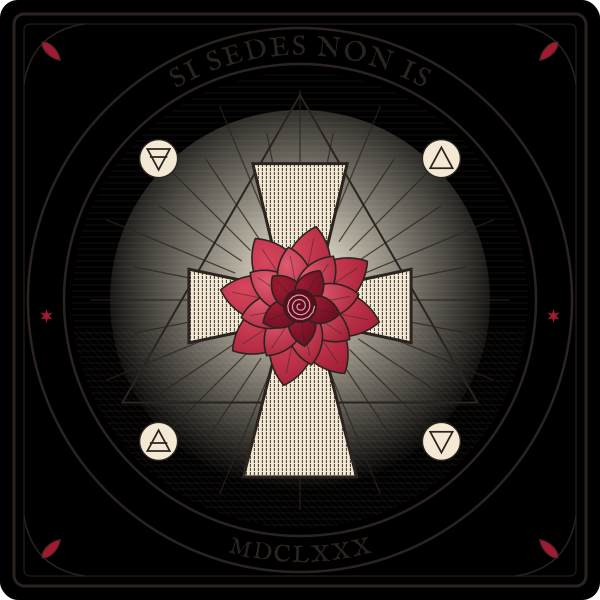
The Alchemical Door of Rome
The last door of a vanished villa on the Esquiline, covered with planetary symbols and Latin mottoes: the Marquis Palombara, Queen Christina and the legend of the pilgrim who made gold.
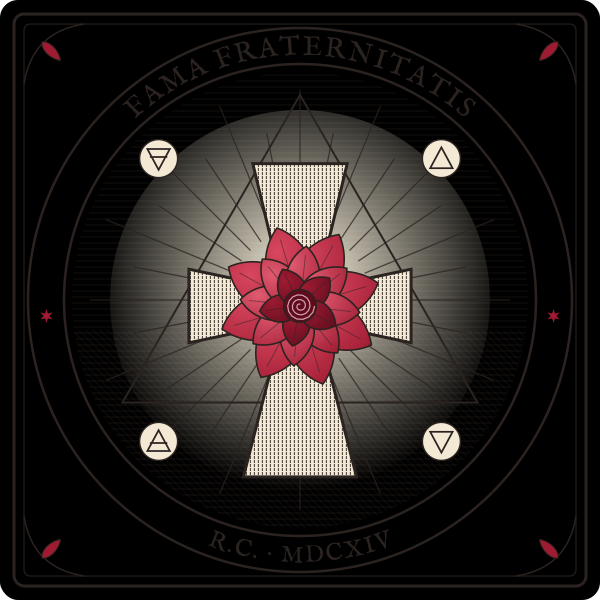
The Rosicrucian Manifestos
Between 1614 and 1616 three anonymous booklets announce to Europe the existence of a secret brotherhood of sages. Nobody knows where it is, everybody looks for it: so the Rosicrucian myth is born.
