
People
Heinrich Khunrath and the Amphitheatre of Wisdom
A Paracelsian physician from Leipzig joined prayer, Christian Kabbalah and alchemy in a book of circular plates: the laboratory beside the oratory, the most famous image of Hermetic knowledge.
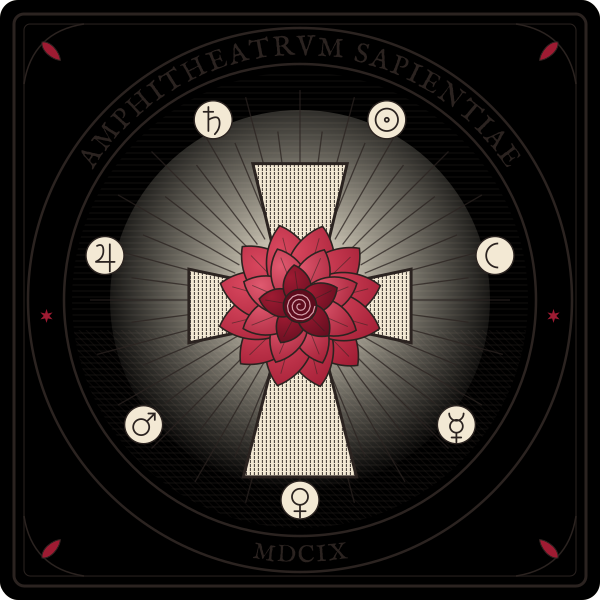
Heinrich Khunrath was born in Leipzig around 1560 and took his doctorate in medicine at Basel in 1588 with a thesis of Paracelsian inspiration. He practised as a physician in various cities of Germany and Bohemia and died in Dresden in 1605, aged little more than forty. He left a work which, together with the Rosicrucian manifestos of a few years later, defines the imagery of early seventeenth-century Christian esotericism: the Amphitheatre of Eternal Wisdom.
A book of images
The first edition appeared in Hamburg in 1595; the most famous, posthumous one was printed at Hanau in 1609. The text comments on verses of the Bible, especially the wisdom books, but the strength of the book lies in its large engraved plates, almost all circular, meant to be looked at for a long time as objects of meditation. They show the crucified Christ at the centre of a rose of light, the primordial Adam, the ladder of seven steps, the alchemical citadel with its twenty-one gates.
Laboratory and oratory
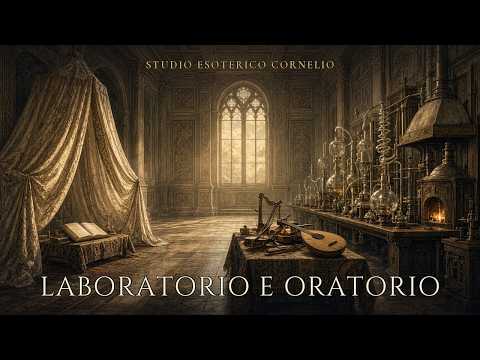
The most famous plate shows a large room divided in two. On the left is an oratory, with the alchemist kneeling in prayer before a tent; on the right the laboratory, with furnaces, stills and instruments; in the middle a table with musical instruments, because music drives away sadness and evil spirits. The message is that the alchemical work is both labour and prayer: ora et labora, but directed at the transformation of matter and of the soul.
Christian Kabbalah
Khunrath took Christian Kabbalah from the humanists: the four-letter name of God, the Tetragrammaton, becomes in Christ a name of five letters, with one letter added in the middle. He drew it at the centre of a five-pointed star, within rays of light. It is a way of saying that the incarnation makes pronounceable and visible what was hidden.
The link with the Rosicrucians
Khunrath died before the Fama Fraternitatis, but many of the manifestos' first readers regarded him as a master. He had met John Dee during a stay in Bremen and shared with the Paracelsians the idea of a Christian wisdom grounded in nature and Scripture. His plates were condemned by the theology faculty of the Sorbonne in 1625, a sign of how widely they had spread.
An icon of esotericism
The images of the Amphitheatre have been reproduced countless times, from nineteenth-century books to modern book covers. Looking at them helps one understand the climate in which the manifestos were born and in which Michael Maier and Robert Fludd worked: a knowledge that did not yet separate the laboratory from prayer.
Watch the video
Sources and further reading
- H. Khunrath, Amphitheatrum sapientiae aeternae (Hamburg 1595; Hanau 1609)
- C. Gilly (ed.), Cimelia Rhodostaurotica (1995)
- P. J. Forshaw, studies on Heinrich Khunrath (2005-2015)
- F. A. Yates, The Rosicrucian Enlightenment (1972)
- U. Szulakowska, The Alchemy of Light (2000)
Read next
Johann Valentin Andreae, the theologian behind the Rosicrucians
Grandson of a Lutheran reformer, traveller, utopian, admirer of Campanella: the man who wrote the Chymical Wedding and then called the whole Rosicrucian affair “a game”.
Michael Maier and Robert Fludd, defenders of the Fraternity
An alchemist physician at the court of Rudolf II and a London physician with a passion for the cosmos: the two great defenders of the Rosicrucians and their illustrated books, masterpieces of seventeenth-century engraving.
Cagliostro, the magician from Palermo
Born Giuseppe Balsamo in the Albergheria quarter, he became Count Cagliostro: healer, founder of an Egyptian Freemasonry, protagonist of the necklace scandal, who died a prisoner at San Leo.
