
Orders and societies
The degree of Knight Rose-Croix
In the Ancient and Accepted Scottish Rite the eighteenth degree bears the name of the Rose+Cross: the lost word recovered, the pelican, the cross and the rose, faith, hope and charity.
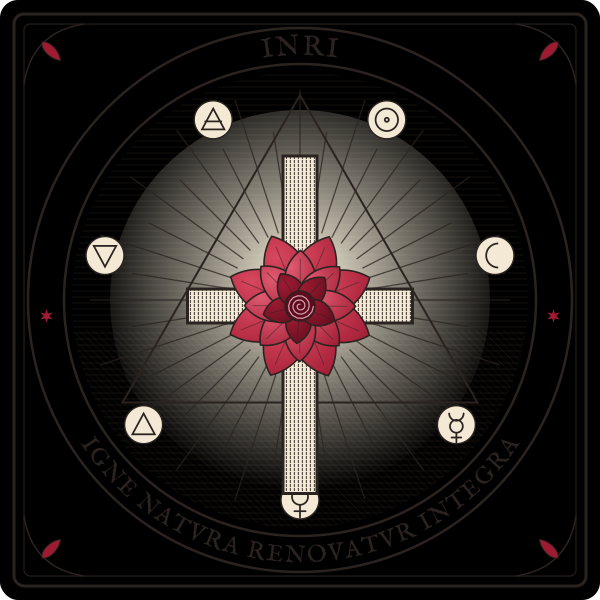
In Freemasonry the first three degrees, Entered Apprentice, Fellow Craft and Master Mason, are common to all rites. Above them, in the eighteenth century, dozens of "high degrees" arose, with chivalric, biblical and Hermetic names. One of the most important bears the name of the Rose+Cross: in the Ancient and Accepted Scottish Rite, codified in 1801 at Charleston, it is the eighteenth of thirty-three degrees, known as Knight or Prince Rose-Croix.
A degree born in France
The degree appears in France around the middle of the eighteenth century, under the name of Knight of the Eagle and the Pelican or Knight Rose-Croix. In the French Rite it became the last and highest of the superior orders. Its link with the seventeenth-century Rosicrucians is above all symbolic: it takes over the name and the cross with the rose, not a historical descent from the Fraternity of the manifestos.
The lost word
In the third Masonic degree the Master dies without revealing the secret word, and the word remains lost. The eighteenth degree tells of its rediscovery. The candidate passes through a time of darkness and confusion, in which the columns are broken and the tools scattered, and at last finds the word in the four letters set above the cross: INRI. In the Christian reading they are the initials of Pilate's inscription; in the Hermetic reading they become the motto Igne Natura Renovatur Integra, the whole of nature is renewed by fire.
The pelican
The degree's main symbol is the pelican tearing its breast to feed its young with its own blood: an ancient image of Christ, taken up by alchemy too to indicate the stone that multiplies by giving itself and the vessel of circular distillation. Beside the pelican appear the cross with the rose, the eagle and the three theological virtues, faith, hope and charity, which the degree presents as the new law.
A Christian or a universal degree?
In the different obediences the degree has taken on different meanings. In England it is conferred in a rite that requires Trinitarian Christian faith; in the United States Albert Pike, in his Morals and Dogma, interpreted it as a universal teaching, valid for every religion. In many chapters a fraternal banquet, the agape, with bread and wine, is still celebrated.
Why it matters
The Rose-Croix degree brought the symbol of the Rose+Cross into the heart of Freemasonry, where it has shaped generations of initiates. For its symbols see the symbol of the Rose+Cross and the alchemical motto V.I.T.R.I.O.L.; for another Christian initiatory path born of eighteenth-century Freemasonry, Martinism.
Watch the video
Sources and further reading
- A. Pike, Morals and Dogma of the Ancient and Accepted Scottish Rite (1871)
- R. Le Forestier, La Franc-Maçonnerie templière et occultiste aux XVIIIe et XIXe siècles (1970)
- Supreme Council 33°, Grand Constitutions (1786, traditional text)
- P. Naudon, Histoire générale de la franc-maçonnerie (1981)
- J. Mandleberg, Ancient and Accepted (1995)
Read next
The Hermetic Order of the Golden Dawn
London, 1888: three Freemasons found the Golden Dawn, the school of ceremonial magic that trained Yeats, Waite and Crowley, built its grades on the Tree of Life and shaped the whole of twentieth-century occultism.
Martinism
A mysterious theurgist, Martinez de Pasqually; his secretary Louis-Claude de Saint-Martin, the “Unknown Philosopher”; and the order founded by Papus: the way of the heart of French Christian esotericism.
The Invisible College
A castle with wings and wheels, posters on the walls of Paris, Descartes under suspicion, Boyle and the birth of the Royal Society: how the Fraternity no one could find became an idea.
