
People
John Dee and the Hieroglyphic Monad
Mathematician to Elizabeth I, book collector, interpreter of angels: his monad sign reappears in the Chymical Wedding, and for Frances Yates the Rosicrucians were born in his wake.
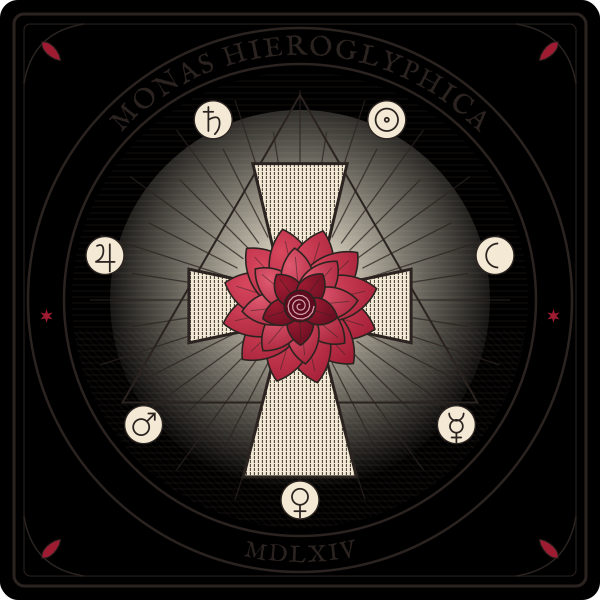
John Dee was born in London in 1527, into a family of Welsh origin. He studied at Cambridge and at universities on the Continent, became one of the finest mathematicians in England and a trusted adviser to Queen Elizabeth I, for whom he even calculated the most favourable day for her coronation. In his house at Mortlake, on the Thames, he gathered the largest private library in the kingdom. But his name is linked above all to a small book and to a long dialogue with angels.
One sign for the cosmos
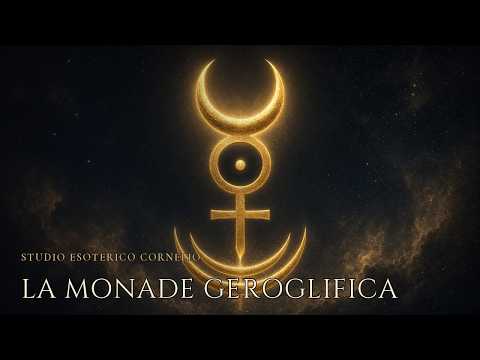
In 1564, in Antwerp, Dee published the Monas Hieroglyphica, dedicated to Emperor Maximilian II. In twenty-four theorems he explains a single glyph of his own design: the circle of the Sun with the point at its centre, the crescent of the Moon, a cross and, at the base, the sign of Aries. According to Dee that sign, analysed with geometry, contained the principles of astronomy, alchemy and Kabbalah: a universal language able to sum up creation.
Conversations with angels
From 1582 Dee sought an even higher knowledge. With the help of a medium, Edward Kelley, he consulted a crystal stone, convinced that he was receiving messages from angels, who also dictated a language later called Enochian. The two travelled to Poland and Bohemia, to the court of Rudolf II in Prague and to Count Rožmberk, between hopes of patronage and suspicion. Dee returned to England in 1589 to find his library plundered. He died poor at Mortlake in 1608 or 1609.
The monad in the Chymical Wedding
In 1616 The Chymical Wedding of Christian Rosenkreutz was published in Strasbourg. At the beginning of the story the hero receives a sealed letter of invitation, and beside the text appears a symbol: John Dee's monad. We do not know for certain what Johann Valentin Andreae meant by it, but the signal is clear: the writer knew the Monas and wanted to tie his story to that ideal of universal wisdom.
Frances Yates's thesis
In 1972 the historian Frances Yates, in The Rosicrucian Enlightenment, proposed that the Rosicrucian movement was the German echo of ideas spread by Dee during his stay in central Europe: a reform at once scientific, religious and political, backed by Protestant princes. The thesis has been much debated and partly scaled back, but it made Dee a key figure in the prehistory of the Rosicrucians.
Magician and mathematician
For centuries Dee was seen either as a charlatan or as a magician, whereas historians today study him as a Renaissance intellectual for whom mathematics, magic and religion were parts of the same knowledge. To follow his legacy, read the Chymical Wedding and the symbol of the Rose+Cross.
Watch the video
Sources and further reading
- John Dee, Monas Hieroglyphica (Antwerp 1564)
- N. H. Clulee, John Dee's Natural Philosophy. Between Science and Religion (1988)
- D. E. Harkness, John Dee's Conversations with Angels (1999)
- G. Parry, The Arch-Conjuror of England: John Dee (2011)
- F. A. Yates, The Rosicrucian Enlightenment (1972)
Read next
Johann Valentin Andreae, the theologian behind the Rosicrucians
Grandson of a Lutheran reformer, traveller, utopian, admirer of Campanella: the man who wrote the Chymical Wedding and then called the whole Rosicrucian affair “a game”.
Michael Maier and Robert Fludd, defenders of the Fraternity
An alchemist physician at the court of Rudolf II and a London physician with a passion for the cosmos: the two great defenders of the Rosicrucians and their illustrated books, masterpieces of seventeenth-century engraving.
Cagliostro, the magician from Palermo
Born Giuseppe Balsamo in the Albergheria quarter, he became Count Cagliostro: healer, founder of an Egyptian Freemasonry, protagonist of the necklace scandal, who died a prisoner at San Leo.
