
Orders and societies
The Rosicrucians of the twentieth century
Max Heindel's Rosicrucian Fellowship, Harvey Spencer Lewis's AMORC, the Lectorium Rosicrucianum: how the name of the Rose+Cross became that of spiritual movements spread across the world.
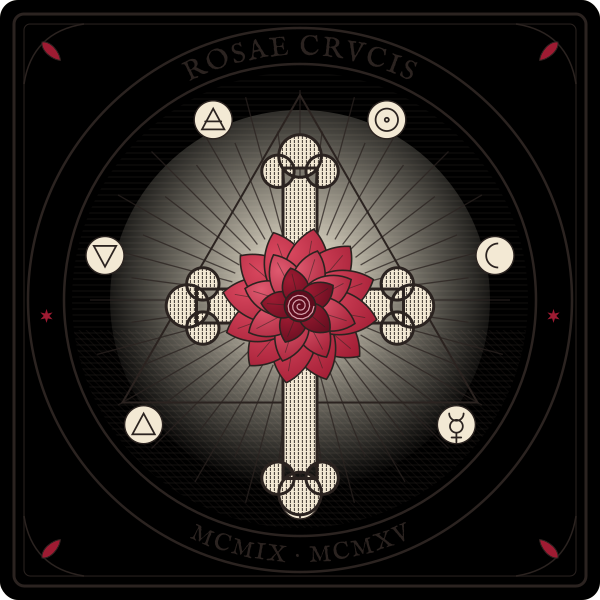
In the twentieth century the name of the Rose+Cross no longer denotes a single tradition, but a family of different movements, often competing with one another, that look back to the manifestos of the seventeenth century. Some were born in the United States, others in Europe; some teach by correspondence, others are organised as spiritual schools. What they share is the idea of an ancient wisdom, handed down by masters and accessible through gradual study.
Nineteenth-century roots
The first to use the name in the United States was Paschal Beverly Randolph, physician and writer, who around the middle of the nineteenth century founded a Fraternitas Rosae Crucis. In Europe, besides the English Societas Rosicruciana, the Kabbalistic Order of the Rose-Croix was founded in France, linked to the same circles as Martinism. Rudolf Steiner, founder of anthroposophy, devoted many lectures to Christian Rosenkreutz, presenting him as a spiritual guide of humanity.
Max Heindel and the Rosicrucian Fellowship
In 1909 Max Heindel, of Danish origin, published The Rosicrucian Cosmo-Conception and founded the Rosicrucian Fellowship, with its headquarters at Oceanside, California. His teaching combines esoteric Christianity, astrology, reincarnation and spiritual healing, partly inspired by Steiner's ideas. The Fellowship spread its lessons by post in many countries.
Harvey Spencer Lewis and AMORC
In 1915 Harvey Spencer Lewis founded in New York the Antiquus Mysticusque Ordo Rosae Crucis, AMORC, later moved to San Jose, California, where he also built an Egyptian museum. The Order presented the Rose+Cross as a tradition born in the mystery schools of ancient Egypt and offered a graded course of study, with lessons sent by correspondence. It has become one of the most widespread Rosicrucian movements in the world.
The Lectorium Rosicrucianum
In the Netherlands, in the 1930s and 1940s, Jan van Rijckenborgh and Catharose de Petri founded the Lectorium Rosicrucianum, the International School of the Golden Rosycross. Its teaching has a Gnostic stamp: the material world is seen as an order from which the soul must free itself through an inner transformation. The Chymical Wedding and the other seventeenth-century texts are read as maps of this path.
Finding one's way
These movements differ in doctrine, organisation and relation to history. The historian sees them as heirs to a myth rather than to an unbroken chain: the Fraternity of the manifestos left no documented traces, but its name has gone on inspiring generations of seekers, like the symbol of the Rose+Cross.
Watch the video
Sources and further reading
- M. Heindel, The Rosicrucian Cosmo-Conception (1909)
- H. S. Lewis, Rosicrucian Questions and Answers (1929)
- R. Steiner, Esoteric Christianity and the Mission of Christian Rosenkreutz (lectures 1911-1912)
- M. Introvigne, Il cappello del mago (1990)
- C. McIntosh, The Rosicrucians (1997)
Read next
The Hermetic Order of the Golden Dawn
London, 1888: three Freemasons found the Golden Dawn, the school of ceremonial magic that trained Yeats, Waite and Crowley, built its grades on the Tree of Life and shaped the whole of twentieth-century occultism.
Martinism
A mysterious theurgist, Martinez de Pasqually; his secretary Louis-Claude de Saint-Martin, the “Unknown Philosopher”; and the order founded by Papus: the way of the heart of French Christian esotericism.
The Invisible College
A castle with wings and wheels, posters on the walls of Paris, Descartes under suspicion, Boyle and the birth of the Royal Society: how the Fraternity no one could find became an idea.
